



ventas@cota.com.mx | info@cota-cleanpartners.com

+52 55 5341 3116 | +1 423 716 4093

Technical Cleanliness

Understanding contamination is the first step to controlling it. Here’s what technical cleanliness means — and why it matters for your components.

Cleanliness Is a Measurable, Controllable Property of Your Components

Technical cleanliness refers to the quantitative evaluation of particulate contamination present on or inside an industrial component — and its compliance with the cleanliness specifications defined by the customer or applicable standard.

It is not a visual assessment. It is a structured analytical process that extracts, collects, and classifies particles by size, quantity, and material category: metallic, non-metallic, and fiber. — producing objective, traceable data that can be compared against defined acceptance criteria.

In the automotive supply chain and other precision manufacturing industries, technical cleanliness is a formal quality requirement. Components are evaluated before reaching the assembly line to confirm they are within acceptable contamination limits.

A Single Particle in the Wrong Place Can Shut Down a Production Line

Particulate contamination in precision components is one of the leading causes of assembly failures, premature wear, and warranty claims in manufacturing — particularly in hydraulic systems, fuel systems, transmissions, and electronic assemblies.

The consequences of non-compliance are concrete: rejected parts, halted production, costly rework, and damaged relationships with OEM customers. In many cases, the contamination was present throughout the entire process — it simply was never measured.

Technical cleanliness analysis gives you the evidence to prove compliance, identify contamination sources, and make informed decisions before problems reach your customer.

What makes technical cleanliness a rigorous, reliable discipline.

Quantitative, Not Visual

Results are expressed in particle counts, size classifications, and mass — not subjective observations. Every analysis produces traceable, documented data.

Controlled Environment Required

Reliable results depend on performing extraction and analysis under controlled conditions — clean room, documented procedures, and calibrated equipment — to avoid external contamination.

Standards-Based

Evaluations are performed according to established international standards — ISO 16232, VDA 19.1 and VDA 19.2 — ensuring comparability and acceptance across the global supply chain.

Applied Throughout the Process

Technical cleanliness is evaluated at multiple stages — new part validation, production monitoring, customer compliance confirmation, and contamination investigations.

From Sample Reception to Technical Report — Five Defined Stages

Every technical cleanliness inspection follows a structured, documented sequence.
Each stage is critical to ensure the integrity of the results.

1

The component is received and all relevant information is confirmed: applicable standard, cleanliness specification, particle size and mass limits, and any special customer or OEM requirements.

2

Particles are removed from the component using the method defined by the standard: pressure rinsing, ultrasonic extraction, internal rinsing, agitation or air jet — performed in a controlled environment.

3

The extraction fluid is passed through a membrane filter that collects all particles for subsequent analysis. Filter integrity is verified to ensure no external contamination is introduced.

4

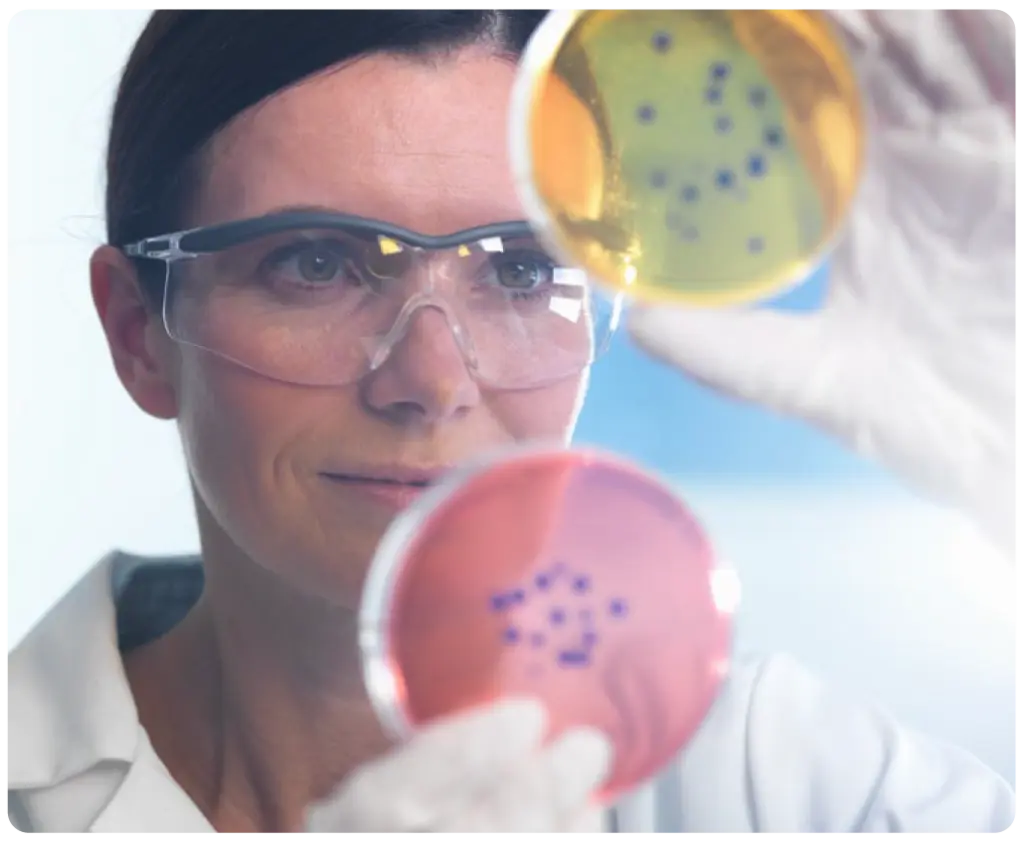
The filter is analyzed using optical microscopy with the Filtrex system, detecting particles down to 5 microns. Particles are classified by size range, quantity, and material type (metallic, non-metallic, fiber).

5

A structured technical report is delivered with complete particle data and compliance determination against the applicable specification. We also support you in understanding how the results relate to your cleanliness requirements.

Built on International Technical Cleanliness Standards

Our analyses and processes are aligned with the primary international standards governing technical cleanliness in industrial components. These standards define extraction methods, analytical procedures, and reporting requirements.

ISO 16232

The international standard for cleanliness of components and systems for road vehicles. Defines the full methodology for extraction, filtration, and particle analysis in automotive components.

VDA 19.2

Addresses contamination control in assembly processes — including environment, personnel, logistics, and manufacturing conditions, with methods such as particle trap analysis (Illig value).

VDA 19.2

The German automotive standard (equivalent to ISO 16232) governing technical cleanliness inspection of functional components. Widely required by OEMs and Tier 1 suppliers.

We also work with OEM-specific cleanliness requirements from Ford, Cummins, BMW, Mercedes Benz, ZF, Hella, Daimler, Navistar,Caterpillar, and other customers when applicable.

Typical Applications

Technical cleanliness analysis is required at different points in the product lifecycle.
These are the situations where our clients typically engage us:

New Part Validation

Confirm that new component numbers meet cleanliness requirements before entering production.

OEM Compliance Confirmation

Demonstrate compliance with customer-specified cleanliness limits as part of PPAP or delivery approval processes.

Contamination Investigation

Identify the source and nature of contamination when a component fails to meet specifications or an assembly issue is detected.

Audit Documentation

Generate the technical evidence required to support quality audits and customer reviews related to cleanliness control.

+52 55 5341 3116

Ready to evaluate the cleanliness level of your components?